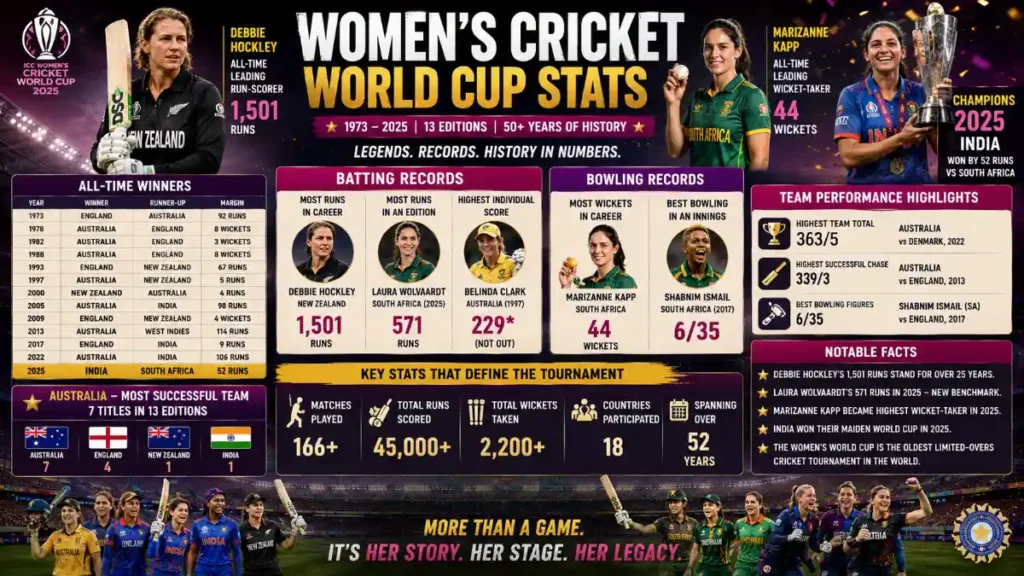

The Women’s Cricket World Cup, first held in 1973, is the oldest limited-overs cricket tournament in the world. Across 13 editions, it has produced iconic women’s cricket World Cup stats — New Zealand’s Debbie Hockley leads all-time run-scorers with 1,501 runs, South Africa’s Marizanne Kapp became the leading wicket-taker with 44 wickets at the 2025 edition, Laura Wolvaardt set the single-edition batting record with 571 runs in 2025, and Australia has won the title seven times — more than any other nation. The 2025 edition, held in India, was the most statistically dominant tournament in the competition’s history.
Thirteen editions. Over five decades. Numbers that rewrite cricket history almost every four years.
The Women’s Cricket World Cup is not just a sport — it is a pressure test conducted in front of the world, where careers are defined in a single innings, and legacies are written by a single over. The women’s cricket World Cup stats that emerge from these tournaments are not just figures on a page. They are stories compressed into digits, rivalries captured in averages, and history recorded in scorecards.
This deep dive covers every major batting record, bowling milestone, team performance benchmark, and key women’s ODI World Cup records — including what the 2025 edition changed forever. Whether you are searching for the highest run-scorer in Women’s World Cup history, the most wickets taken, or the records broken in 2025, this is the only guide you need.
The Women’s World Cup: A Quick Historical Foundation
The first Women’s Cricket World Cup was held in England in 1973, two years before the inaugural men’s tournament, making it the oldest limited-overs cricket World Cup in history. Australia has dominated the tournament with seven titles, while India claimed their first-ever championship at the 2025 edition.
The tournament began in 1973 — two years before the men’s World Cup — making it the first major limited-overs cricket tournament in history. England hosted and won that inaugural edition, with Enid Bakewell scoring a decisive 118 in the final against Australia. That performance set the tone for a competition that would become the highest stage in women’s cricket.
Since then, 13 editions have been played across eight countries. Australia leads the trophy count with seven titles. England has won four times. New Zealand claimed one, and India claimed their first-ever title at the 2025 edition, ending a heartbreaking run of three final defeats.
What most analysts consistently overlook: Australia’s dominance through the 1990s and 2000s was not just about individual talent. It was built on batting depth, consistent top-order partnerships averaging above 60 in knockout games, and a bowling group that collectively rotated pressure across all 50 overs. Every set of women’s cricket World Cup stats from that era tells the same structural story.
Edition-by-Edition Winners — Complete List
| Year | Winner | Runner-Up | Margin |
| 1973 | England | Australia | 92 runs |
| 1978 | Australia | England | 8 wickets |
| 1982 | Australia | England | 3 wickets |
| 1988 | Australia | England | 8 wickets |
| 1993 | England | New Zealand | 67 runs |
| 1997 | Australia | New Zealand | 5 runs |
| 2000 | New Zealand | Australia | 4 runs |
| 2005 | Australia | India | 98 runs |
| 2009 | England | New Zealand | 4 wickets |
| 2013 | Australia | West Indies | 114 runs |
| 2017 | England | India | 9 runs |
| 2022 | Australia | India | 106 runs |
| 2025 | India | South Africa | 52 runs |
The most striking pattern: Australia and England dominated the first seven finals, meeting five times. The last four finals have all featured India — a transformation that reflects the structural rise of women’s cricket on the subcontinent, backed by BCCI investment, the Women’s IPL, and a generational shift in domestic talent.
What most people miss: India appeared in four finals (2005, 2017, 2022, 2025) and lost three before breaking through. Each near-miss was painful — 98 runs in 2005, 9 runs in 2017 (the cruellest), 106 runs in 2022. The margin that finally went India’s way in 2025 was 52 runs.
All-Time Batting Records: The Numbers Behind the Legends
Quick Answer: New Zealand’s Debbie Hockley holds the all-time Women’s Cricket World Cup batting record with 1,501 runs. Laura Wolvaardt set the single-edition record with 571 runs at the 2025 tournament. Australia’s Belinda Clark holds the highest individual score — an unbeaten 229 in the 1997 edition.
When discussing women’s cricket World Cup stats in batting, three categories define greatness: career runs, single-edition dominance, and individual innings impact. Each tells a different story.
Most Runs in Women’s World Cup History — Top 10
| Rank | Player | Country | Editions | Runs | Hundreds |
| 1 | Debbie Hockley | New Zealand | 1982–2000 | 1,501 | 2 |
| 2 | Mithali Raj | India | 2000–2022 | 1,321 | 2 |
| 3 | Jan Brittin | England | 1982–1993 | 1,299 | 3 |
| 4 | Charlotte Edwards | England | 1993–2013 | 1,294 | 4 |
| 5 | Suzie Bates | New Zealand | 2009–2025 | 1,179+ | 4 |
| 6 | Karen Rolton | Australia | 1997–2005 | 1,002 | 2 |
| 7 | Belinda Clark | Australia | 1988–2005 | 1,000 | 3 |
| 8 | Harmanpreet Kaur | India | 2013–2025 | 900+ | 2 |
| 9 | Claire Taylor | England | 1997–2009 | 891 | 1 |
| 10 | Smriti Mandhana | India | 2017–2025 | 700+ | 2 |
Debbie Hockley’s record has stood since 2000 — over 25 years. Mithali Raj played in six World Cups, scored in every edition, and still could not overhaul it. That tells you how extraordinary a 1,501-run tally across an era of lower-scoring, two-innings-structured group stages truly is.
Stat That Changed the Record Books
Hockley’s 1,501 runs — set between 1982 and 2000 — have outlasted six editions of the tournament. No active player has yet broken it.
Most Runs in a Single Edition
Laura Wolvaardt of South Africa rewrote this record at the 2025 Women’s Cricket World Cup in India. Her final tally of 571 runs across nine matches — including centuries in the semi-final and final — is the most runs scored by any batter in a single edition of the tournament.
She surpassed the previous record of 509 set by Australia’s Alyssa Healy at the 2022 edition in New Zealand.
| Player | Edition | Runs | Average | Strike Rate | Hundreds |
| Laura Wolvaardt (SA) | 2025 | 571 | 71.38 | 98.89 | 2 |
| Alyssa Healy (AUS) | 2022 | 509 | 56.56 | 107.60 | 1 |
| Smriti Mandhana (IND) | 2025 | 434 | 54.25 | 91.40 | 1 |
| Mithali Raj (IND) | 2017 | 409 | 68.17 | 65.45 | 1 |
| Heather Knight (ENG) | 2025 | 407 | 50.87 | 88.89 | 1 |
Wolvaardt’s 571 came at a strike rate of 98.89 across nine innings, averaging 71.38. She also scored 169 in the semi-final against England — the highest score ever by a captain in a Women’s World Cup knockout game. Despite South Africa losing the final, her campaign was arguably the finest individual batting performance in any Women’s World Cup edition.
Highest Individual Scores in Women’s World Cup History
Australia’s Belinda Clark holds the record for the highest individual score — an unbeaten 229 against Netherlands in the 1997 edition in India. It remains one of the most dominant single innings across all genders and formats of limited-overs cricket.
| Rank | Player | Score | Opponent | Edition |
| 1 | Belinda Clark (AUS) | 229* | Netherlands | 1997 |
| 2 | Chamari Athapaththu (SL) | 178* | Australia | 2017 |
| 3 | Charlotte Edwards (ENG) | 173* | Ireland | 1997 |
| 4 | Harmanpreet Kaur (IND) | 171* | Australia | 2017 |
| 5 | Stafanie Taylor (WI) | 171 | Sri Lanka | 2013 |
The counterintuitive truth here: four of the five highest scores in Women’s World Cup history came in the 1997 and 2017 editions, not the modern high-scoring era. Context matters — 1997 saw mismatches in group stages against lesser-ranked sides, while 2017 featured specific pitch conditions that heavily favoured batting. Women’s cricket World Cup stats without era context are misleading.
Most Centuries in a Career
England’s Nat Sciver-Brunt became the outright record holder for most centuries in Women’s World Cup history at the 2025 edition, reaching five centuries. She surpassed the previous record of four, shared by Suzie Bates, Charlotte Edwards, and Jan Brittin.
Most Successful Captains — Women’s World Cup
| Captain | Country | Finals Played | Titles Won |
| Belinda Clark | Australia | 3 | 2 (1997, 2005) |
| Rachael Heyhoe-Flint | England | 2 | 1 (1973) |
| Harmanpreet Kaur | India | 2 | 1 (2025) |
| Charlotte Edwards | England | 2 | 1 (2009) |
| Lyn Fullston | Australia | 2 | 1 (1982) |
Harmanpreet Kaur’s captaincy journey is one of the most perseverant stories in women’s cricket. She led India to defeat in the 2022 final, then returned in 2025 to finally lift the trophy — making her one of only four captains to win the Women’s Cricket World Cup.
All-Time Bowling Records: When Wickets Tell the Real Story
Quick Answer: South Africa’s Marizanne Kapp is the all-time leading wicket-taker in Women’s Cricket World Cup history with 44 wickets, surpassing India’s Jhulan Goswami (43) during the 2025 edition. New Zealand’s Jackie Lord holds the best bowling figures in a single match with 6/10.
Batting dominates headlines, but women’s cricket World Cup stats in bowling reveal a deeper competitive truth — matches are more often won by sustained bowling excellence than by any single innings.
Most Wickets in Women’s World Cup History — Top 10
| Rank | Player | Country | Editions | Wickets | Best Figures |
| 1 | Marizanne Kapp | South Africa | 2014–2025 | 44 | 5/20 |
| 2 | Jhulan Goswami | India | 2005–2022 | 43 | 4/20 |
| 3 | Cathryn Fitzpatrick | Australia | 1993–2005 | 39 | 4/22 |
| 4 | Ellyse Perry | Australia | 2009–2022 | 36 | 4/16 |
| 5 | Lyn Fullston | Australia | 1982–1988 | 34 | 5/28 |
| 6 | Anya Shrubsole | England | 2013–2022 | 31 | 6/46 |
| 7 | Karen Rolton | Australia | 1997–2005 | 29 | 4/28 |
| 8 | Deepti Sharma | India | 2017–2025 | 28 | 4/18 |
| 9 | Holly Ferling | Australia | 2013–2017 | 26 | 5/26 |
| 10 | Suzie Bates | New Zealand | 2009–2025 | 24 | 3/22 |
For years, Jhulan Goswami held this record at 43 wickets — a milestone she built across five World Cups from 2005 to 2022. At the 2025 edition, South Africa’s Marizanne Kapp broke it, becoming the tournament’s greatest ever wicket-taker.
Kapp’s 5/20 against England in the semi-final in Guwahati was the decisive moment. It sent her to 44 career World Cup wickets, a record achieved across seven editions. What makes this record especially significant: Kapp is also a top-four batter. She represents a rare breed of World Cup cricketer who has consistently impacted results with both bat and ball — a complete player in the truest sense.
Record-Breaking Moment
Marizanne Kapp’s 5/20 in the 2025 semi-final vs England made her the all-time leading wicket-taker in Women’s Cricket World Cup history — surpassing Jhulan Goswami’s 43-wicket record.
Best Bowling Figures in a Single Match
| Figures | Player | Opponent | Edition | Stage |
| 6/10 | Jackie Lord (NZ) | India | 1982 | Group Stage |
| 6/46 | Anya Shrubsole (ENG) | India | 2017 | Final |
| 5/20 | Marizanne Kapp (SA) | England | 2025 | Semi-Final |
| 5/26 | Holly Ferling (AUS) | South Africa | 2013 | Group Stage |
| 5/28 | Lyn Fullston (AUS) | England | 1982 | Final |
Only four players in Women’s World Cup history have taken six-wicket hauls in a single match. New Zealand spinner Jackie Lord’s 6/10 remains the most economical. But the most pressure-defining six-wicket haul belongs to Anya Shrubsole — her 6/46 in the 2017 final at Lord’s, defending a modest target, remains the most consequential bowling performance in Women’s World Cup knockout history.
Most Wickets in a Single Edition
The 2025 edition became the first since 1982 to produce three bowlers with more than 15 wickets each — a clear sign of how competitive and tactically balanced the teams were. India’s Deepti Sharma led Indian bowling with clinical off-spin variations, while Marizanne Kapp and Shabnim Ismail formed the most dangerous pace partnership in the tournament.
The 2025 Women’s World Cup: A Statistical Landmark Edition
Quick Answer: India won the 2025 ICC Women’s Cricket World Cup, defeating South Africa by 52 runs in the final at Navi Mumbai. The 2025 tournament broke multiple all-time records, including most centuries (15), most sixes (133), and most team totals above 300 (eight) in a single edition.
The 2025 edition was not just a tournament — it was a statistical watershed moment in the history of the women’s game. India posted 298/7 in the final and bowled South Africa out for 246, claiming their maiden Women’s World Cup title.
Records Broken at the 2025 Edition
2025 — The Most Record-Breaking Women’s World Cup in History
- 15 centuries scored — the most ever in a single Women’s World Cup
- Eight team totals of 300-plus — more than the previous two editions combined
- 133 sixes hit — the most in any Women’s World Cup edition
- Three bowlers surpassed 15 wickets — first time since 1982
- Laura Wolvaardt scored 571 runs — the highest ever by a batter in one edition
- Marizanne Kapp became the all-time leading wicket-taker with 44 wickets
- Nat Sciver-Brunt became the first batter to score five World Cup centuries
Smriti Mandhana — Edition Record for India
Smriti Mandhana scored 434 runs in 2025, setting a new record for most runs by an Indian in a single Women’s World Cup. Her tally surpassed Mithali Raj’s 409 from the 2017 edition. With one century, two fifties, and a consistent top-three position throughout, Mandhana’s consistency — not just peak scores — was the platform on which India’s title was built.
Her role at the top of the order changed how teams bowled to India. Opponents could not afford a negative line. That opened up middle-order batters, including Harmanpreet Kaur and Deepti Sharma, to attack.
Harmanpreet Kaur — The Knockout Specialist
India captain Harmanpreet Kaur now holds the record for most runs in Women’s ODI World Cup knockout stages — 331 runs across semi-finals and finals. This is the women’s cricket World Cup stat that receives the least attention but arguably reveals the most about her character as a cricketer.
Her famous 171* against Australia in the 2017 semi-final remains one of the greatest knockout innings in World Cup history — men’s or women’s. The 2025 edition added another knockout contribution that cemented her as the greatest knockout batter in Women’s World Cup history.
The Wolvaardt Paradox
Despite finishing on the losing side, Laura Wolvaardt’s 571-run campaign earned her the No. 1 ICC ODI batting ranking — overtaking Smriti Mandhana (811) with 814 rating points post-tournament. A runner-up medal rarely carries a player to world No. 1. That singular fact summarises just how extraordinary her 2025 performance was.
Women’s World Cup Era Comparison: How the Game Has Changed
Quick Answer: Women’s ODI cricket has undergone a complete transformation in scoring rates. Average team totals have risen from under 180 in the 1970s–1980s to over 260 in the 2022 and 2025 editions, with the 2025 tournament marking the beginning of a new statistical era for the format.
| Era | Avg Team Score | 300+ Totals in Edition | Centuries Per Edition | Avg SR |
| 1973–1988 | 145–170 | 0 | 1–2 | ~52 |
| 1993–2000 | 185–210 | 1–2 | 2–4 | ~62 |
| 2005–2013 | 215–235 | 2–3 | 3–5 | ~70 |
| 2017–2022 | 240–265 | 3–5 | 6–10 | ~78 |
| 2025 | 272+ | 8 | 15 | ~85 |
This table is not a trend — it is a revolution.
The 2025 edition permanently shifted the scoring baseline for women’s ODI cricket. Eight 300-plus totals in a single tournament means that 270 is now a below-par total. Any Women’s World Cup stat analysis that does not account for this era shift will produce misleading comparisons.
Best Knockout Performances in Women’s World Cup History
Quick Answer: The greatest knockout performances in Women’s Cricket World Cup history include Harmanpreet Kaur’s 171* in the 2017 semi-final, Anya Shrubsole’s 6/46 in the 2017 final, and Laura Wolvaardt’s 169 in the 2025 semi-final. These innings and spells define why knockout cricket is the real measure of a World Cup cricketer.
Greatest Batting Performances in Knockouts
| Player | Score | Match | Edition |
| Harmanpreet Kaur (IND) | 171* (off 115 balls) | Semi-final vs AUS | 2017 |
| Laura Wolvaardt (SA) | 169 | Semi-final vs ENG | 2025 |
| Karen Rolton (AUS) | 107* | Final vs IND | 2005 |
| Alyssa Healy (AUS) | 170 | Semi-final vs WI | 2022 |
| Smriti Mandhana (IND) | 90 | Final vs SA | 2025 |
Greatest Bowling Performances in Knockouts
| Player | Figures | Match | Edition |
| Anya Shrubsole (ENG) | 6/46 | Final vs IND | 2017 |
| Marizanne Kapp (SA) | 5/20 | Semi-final vs ENG | 2025 |
| Cathryn Fitzpatrick (AUS) | 4/27 | Final vs IND | 2005 |
| Deepti Sharma (IND) | 4/18 | Semi-final vs AUS | 2025 |
The group stage numbers are relevant, but the women’s cricket World Cup stat that truly defines a player is their knockout average. Harmanpreet’s 171* was scored off 115 balls against an Australian attack that had eliminated nearly every team it faced. Context and pressure transform statistics from data into legacy.
Original Observations: What the Stats Actually Reveal
Observation 1 — The Knockout Amplifier Effect
Nearly every iconic women’s cricket World Cup record — Harmanpreet’s 171*, Wolvaardt’s 169, Shrubsole’s 6/46 — happened in knockouts. Group stage numbers build averages. Knockout numbers build legacies. Harmanpreet Kaur’s 331 knockout runs are not just the record — it is a personality marker. She is a different cricketer when the margin for error disappears.
Observation 2 — The 2025 Edition Ended One Era and Began Another
Eight totals of 300-plus in one edition are not a statistical spike. It is a structural signal that women’s ODI cricket has crossed a threshold. The generation of batters who grew up with the Women’s IPL, stronger domestic T20 leagues, and high-performance programmes globally are now arriving at World Cups with strike rates that were previously impossible in women’s 50-over cricket. Any analyst or selector still using pre-2025 women’s cricket World Cup stats as the primary benchmark is working from an outdated model.
Observation 3 — Debbie Hockley’s Record Is More Vulnerable Than Anyone Acknowledges
Hockley’s 1,501 runs stood unchallenged for 25 years. With Suzie Bates at 1,179 entering 2025, and active players like Mandhana, Sciver-Brunt, and Wolvaardt accumulating runs in high-scoring modern editions, this record could fall before 2030. Consider: Wolvaardt scored 571 in one tournament alone. Two more editions at that rate would demolish every career batting benchmark in the history of women’s cricket World Cup stats.
Frequently Asked Questions
Q1: Who has scored the most runs in Women’s Cricket World Cup history?
New Zealand’s Debbie Hockley leads all-time with 1,501 runs across 45 matches between 1982 and 2000. Mithali Raj of India is second with 1,321 runs, and England’s Jan Brittin is third with 1,299 runs.
Q2: Who scored the most runs in the Women’s Cricket World Cup 2025?
South Africa’s Laura Wolvaardt scored 571 runs in the 2025 edition — the highest by any batter in a single Women’s World Cup, surpassing Alyssa Healy’s 509 from the 2022 edition.
Q3: Who is the all-time leading wicket-taker in Women’s World Cup history?
South Africa’s Marizanne Kapp became the all-time leading wicket-taker at the 2025 edition with 44 wickets, surpassing India’s Jhulan Goswami, who held the record with 43 wickets.
Q4: What is the highest individual score in Women’s Cricket World Cup history?
Australia’s Belinda Clark scored an unbeaten 229 against Netherlands in the 1997 edition in India — the highest score ever recorded in Women’s Cricket World Cup history.
Q5: How many times has Australia won the Women’s Cricket World Cup?
Australia has won the Women’s Cricket World Cup seven times — in 1978, 1982, 1988, 1997, 2005, 2013, and 2022 — making it the most successful nation in the tournament’s history.
Q6: Who won the Women’s Cricket World Cup 2025?
India won the 2025 ICC Women’s Cricket World Cup, defeating South Africa by 52 runs in the final at Navi Mumbai. India posted 298/7 and bowled South Africa out for 246.
Q7: What records did Smriti Mandhana set at the 2025 Women’s World Cup?
Smriti Mandhana scored 434 runs in the 2025 edition — the most by any Indian in a single Women’s Cricket World Cup — surpassing Mithali Raj’s record of 409 set in 2017.
Q8: What is Harmanpreet Kaur’s record in Women’s World Cup knockout matches?
Harmanpreet Kaur holds the record for most runs in the knockout stages of the Women’s ODI World Cup with 331 runs across semi-finals and finals, including her iconic 171* against Australia in the 2017 semi-final.
Q9: How many centuries were scored at the 2025 Women’s Cricket World Cup?
A record 15 centuries were scored at the 2025 Women’s Cricket World Cup — the most in any edition. The 2025 tournament also saw 133 sixes and eight-team totals of 300 or more.
Q10: When was the first Women’s Cricket World Cup held and who won it?
The first Women’s Cricket World Cup was held in England in 1973, two years before the inaugural Men’s Cricket World Cup. England won the inaugural edition, with Enid Bakewell scoring 118 in the final against Australia.