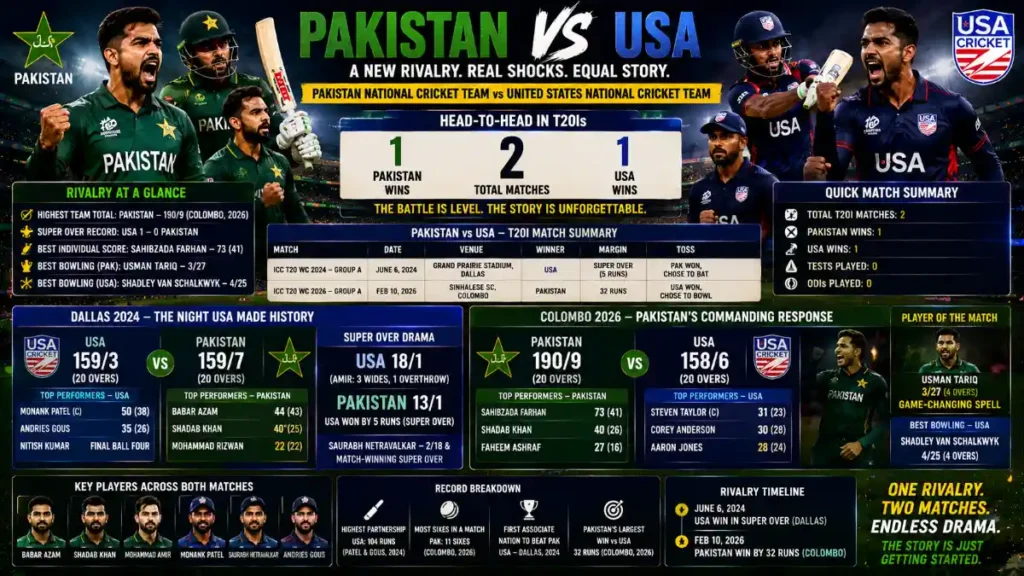

The Pakistan national cricket team vs the United States national cricket team rivalry stands at 1-1 in T20 Internationals. USA shocked Pakistan in a Super Over at the 2024 T20 World Cup in Dallas, and Pakistan levelled the series with a commanding 32-run win at the 2026 T20 World Cup in Colombo.
Pakistan vs USA Cricket: Quick Match Summary
Before anything else, here is the fastest answer to what you are searching for.
| Category | Detail |
| Total T20I Matches | 2 |
| Pakistan Wins | 1 |
| USA Wins | 1 |
| First Match | Grand Prairie Stadium, Dallas — June 6, 2024 |
| Latest Match | Sinhalese SC, Colombo — February 10, 2026 |
| Most Runs (PAK) | Sahibzada Farhan — 73 off 41 (2026) |
| Most Wickets (PAK) | Usman Tariq — 3/27 (2026) |
| Best Bowling (USA) | Shadley van Schalkwyk — 4/25 (2026) |
| Most Famous Result | USA Super Over win in Dallas, 2024 |
| Tests Played | 0 |
| ODIs Played | 0 |
The Pakistan national cricket team vs United States national cricket team record is perfectly level — one extraordinary win each, both in high-pressure World Cup group stages.
Head-to-Head Record: Pakistan vs USA in T20 Internationals
Pakistan and the USA have met twice in T20I cricket — both times at the ICC Men’s T20 World Cup. The head-to-head is level at 1-1, with both victories coming in genuinely consequential matches that impacted group standings and tournament narratives.
| Match | Date | Venue | Winner | Margin | Toss |
| ICC T20 WC 2024 — Group A | June 6, 2024 | Grand Prairie Stadium, Dallas | USA | Super Over (5 runs) | Pakistan won, chose to bat |
| ICC T20 WC 2026 — Group A | Feb 10, 2026 | Sinhalese SC, Colombo | Pakistan | 32 runs | USA won, chose to bowl |
What separates this head-to-head from other bilateral rivalries is that neither result was a routine win. The 2024 match produced one of cricket’s most stunning Super Over finishes. The 2026 match produced a clinical, dominant Pakistani batting performance. Both fixtures rewarded attentive viewers.
Rivalry at a Glance
- Highest team total: Pakistan — 190/9 (Colombo, 2026)
- Lowest defending total won: USA defended nothing — they chased in Dallas
- Super Over record: USA 1, Pakistan 0
- Best individual score: Sahibzada Farhan, 73 off 41 (Pakistan, 2026)
- Best bowling figures: Shadley van Schalkwyk, 4/25 (USA, 2026)
Dallas 2024: The Night USA Rewrote Cricket History
In the 2024 T20 World Cup match at Dallas, Pakistan and USA tied at 159 runs each, forcing a Super Over. USA scored 18 runs while Pakistan managed only 13, giving USA a historic five-run victory — the first time an Associate nation had defeated Pakistan at a T20 World Cup.
June 6, 2024. Grand Prairie Stadium. It was 11 PM local time. Mohammad Amir ran in to bowl Pakistan’s Super Over. The match was tied. Pakistan had experienced these pressure moments before.
What happened next changed both teams’ trajectories permanently.
Pakistan’s Batting: A Rescue Act That Fell Short
Pakistan batted first and posted 159/7 in 20 overs. It was not a fluent innings. The top order crumbled early, and Babar Azam (44 off 43) and Shadab Khan (40 not out off 25) repaired the damage. But 159 on a flat Dallas pitch — with a short square boundary — was a score that demanded a perfect bowling and fielding performance to defend.
Pakistan got neither.
Key Pakistan batting performance — Dallas 2024:
- Babar Azam: 44 off 43 balls
- Shadab Khan: 40* off 25 balls
- Mohammad Rizwan: 22 off 22 balls
- Total: 159/7 in 20 overs
USA’s Chase: Composure Nobody Expected
USA’s approach to chasing 160 was structured, calm, and tactically superior to Pakistan’s bowling plan. Captain Monank Patel scored 50 off 38, and Andries Gous contributed 35 off 26, constructing the kind of opening partnership that gave middle-order batters a platform.
With 56 needed from 44 balls, the chase was difficult but alive. Then Nitish Kumar hit the final ball of the 20th over for four — scores level at 159. Super Over.
Key USA batting performance — Dallas 2024:
- Monank Patel: 50 off 38 balls (captain’s innings)
- Andries Gous: 35 off 26 balls
- Nitish Kumar: tied the match on the last ball
- Total: 159 in 20 overs
What Actually Happened in the Super Over
USA scored 18 runs in the Super Over. Mohammad Amir conceded three wides, and there were overthrows, including a critical misfield from Mohammad Rizwan. Pakistan needed 19 in reply and scored only 13. Saurabh Netravalkar bowled the Super Over for USA — wide-less, composed, and match-defining.
What most people miss: the focus always lands on Amir’s wides. But the deeper tactical failure was Pakistan’s fielding system under pressure. The Rizwan overthrow was not a random error — it reflected a team that had not practised high-pressure execution with the same rigour it practised batting or bowling.
Super Over breakdown:
| Team | Runs | Wides | Key Moment |
| USA | 18 | 0 | Aaron Jones hit one boundary; rest came from wides and overthrows |
| Pakistan | 13 | 3 (by Amir in USA’s over) | Failed to reach 19-run target |
What people assume: The USA got lucky with wides.
What actually happened: USA executed their Super Over perfectly. Pakistan handed them runs, then could not build on them under pressure.
This was Pakistan’s third defeat in four Super Over or bowl-out situations in international cricket. That is not misfortune. That is a pattern rooted in how the team trains for tied-game scenarios.
Saurabh Netravalkar: More Than a Super Over Hero
Saurabh Netravalkar finished the match with figures of 2/18 in his four regular overs, then delivered an immaculate Super Over to win the match for USA. He was named ESPNcricinfo’s Men’s Associate Bowler of the Year for 2024.
Netravalkar’s story adds important context to this Pakistan national cricket team vs United States national cricket team fixture. A software engineer at Oracle in real life, Netravalkar represents the diaspora backbone of USA cricket — technically trained, internationally competitive, and playing with zero fear of reputation.
His Super Over delivery was not very accurate. It was a rehearsed skill performed under maximum pressure.
Colombo 2026: Pakistan’s Clinical Revenge
In the 2026 T20 World Cup rematch, Pakistan scored 190/9 against USA and restricted them to 158/8, winning by 32 runs. Sahibzada Farhan’s 73 off 41 and a disciplined spin attack from Usman Tariq (3/27) and Shadab Khan (2/26) powered the victory.
By February 10, 2026, the Pakistan national cricket team vs United States national cricket team match had a completely different weight. Pakistan had the momentum to rebuild. USA came in as the team that had already beaten them once.
USA won the toss and chose to bowl — a decision that backfired spectacularly.
Pakistan’s Innings: Farhan Takes Control
Sahibzada Farhan scored 73 off 41 balls, hitting five sixes and six fours, as Pakistan posted 190/9 — their highest T20 World Cup total since the 2016 edition.
Pakistan lost two early wickets inside the Powerplay, slipping to 56/2. At that point, another batting collapse looked possible.
Then Farhan and Babar Azam (46 off 32) built an 81-run partnership that shifted the entire match. The partnership was significant not just for runs — it was significant because it came after the crisis ball, when Pakistan historically tend to compound their problems.
Pakistan batting — Colombo 2026:
- Sahibzada Farhan: 73 off 41 (5 sixes, 6 fours)
- Babar Azam: 46 off 32
- Partnership (Farhan-Babar): 81 runs post-Powerplay
- Final total: 190/9 in 20 overs
The counterintuitive point: USA’s best bowler, Shadley van Schalkwyk, took 4/25 — an excellent return in any T20 match — and still could not prevent Pakistan crossing 190. That is the measure of how destructive Farhan’s innings was. His strike rate operated at a level that outpaced even the wickets falling around him.
Pakistan’s Spin Strategy: Precision Targeting
Pakistan deployed a spin-heavy attack in Colombo, exploiting the Sinhalese SC surface’s turn and bounce. Usman Tariq (3/27), Shadab Khan (2/26), Abrar Ahmed, Mohammad Nawaz, and Shaheen Afridi all contributed wickets.
USA’s chase started dangerously well. Shayan Jahangir (49 off 34) and Shubham Ranjane (51 off 30) put on a genuine partnership and kept USA’s hopes alive. At 80+ runs, the match was still genuinely competitive.
Then Pakistan’s captain made the key decision: bring spin on from both ends on a pitch with more grip than the flat Dallas surface two years earlier.
This was not a generic bowling rotation. It was targeted tactical exploitation. USA’s batters — most of whom play domestic cricket in conditions where spin is not a consistent threat — had shown in previous fixtures that wrist-spin at good pace caused significant discomfort. Pakistan identified this vulnerability and attacked it precisely.
Pakistan bowling — Colombo 2026:
| Bowler | Overs | Runs | Wickets | Economy |
| Shadley van Schalkwyk (USA bat) | — | — | — | — |
| Usman Tariq | 4 | 27 | 3 | 6.75 |
| Shadab Khan | 4 | 26 | 2 | 6.50 |
| Shaheen Afridi | 4 | 29 | 1 | 7.25 |
| Abrar Ahmed | 4 | 32 | 1 | 8.00 |
| Mohammad Nawaz | 4 | 24 | 1 | 6.00 |
USA final score: 158/8. Pakistan won by 32 runs.
The Ehsan Adil Story Nobody Covered Properly
One of the most unusual subplots of the 2026 fixture: Ehsan Adil, a former Pakistan international fast bowler, represented USA as a replacement player against his own former national team. He had been drafted into the USA squad after injury disruptions in their India match.
He batted and bowled for USA against the country he once represented. In cricket’s modern diaspora era, this is increasingly possible. But it remains one of the sport’s stranger human stories, and it was almost entirely ignored in mainstream coverage of the Pakistan national cricket team vs United States national cricket team fixture.
Pakistan vs USA: Tactical Breakdown
The fundamental tactical difference between these two teams is that Pakistan relies on individual brilliance to solve match problems, while USA builds around collective discipline and tactical structure. These contrasting philosophies explain both results.
Why Pakistan Struggled in Dallas
- Bowling plan under pressure: No clear contingency for a Super Over scenario
- Fielding discipline: Overthrows in the highest-pressure moment of the match
- Super Over selection: Amir was the logical choice — but had no margin for error and used it
- Batting intent: Babar’s 44 off 43 was technically correct but not match-accelerating
Why USA Won in Dallas
- Netravalkar’s discipline: Zero wides in the Super Over, consistent lengths
- Monank Patel’s calmness: Fifty under pressure as captain, setting the tempo
- Collective belief: USA did not panic chasing 160 — they built partnerships methodically
Why Pakistan Won in Colombo
- Farhan’s counter-attacking intent: Attacking from ball one after early wickets is hard — Farhan did it
- Spin targeting: Used Colombo conditions specifically against USA’s weakness
- Batting depth: Even at 56/2, they reached 190 — showing genuine batting resource
Why USA Lost in Colombo
- Spin vulnerability: Tariq, Shadab, Nawaz, and Abrar — four quality spin options are too many for a team that does not train in subcontinent conditions regularly
- Target too steep: 191 on a turning Colombo pitch is genuinely difficult for any side
Structural Difference: How These Two Teams Are Built
Pakistan: Franchise-Hardened, Pressure-Brittle
Pakistan has decades of T20 experience, a pool of PSL and global franchise-tested players, and genuine match-winners across all departments. Their persistent weakness is execution in moments of maximum pressure — specifically tied matches and Super Overs.
The evidence is not just Dallas. Pakistan’s Super Over and bowl-out record across all T20 cricket shows a team that trains brilliantly for normal match scenarios but underinvests in edge-case preparation — those five or ten deliveries where tournaments are won or lost.
Babar Azam, Shaheen Afridi, and Shadab Khan are legitimate world-class operators. But world-class individual performance does not automatically translate to world-class team composure in crises. That gap is what the Pakistan national cricket team vs United States national cricket team rivalry has repeatedly exposed.
USA: Diaspora Power, Structure-First Cricket
USA cricket is built on a foundation of diaspora talent — South Asian and Caribbean-origin players who developed their skills elsewhere before committing to the USA program. The team’s strength is its collective identity and structural clarity, not individual star power.
- Saurabh Netravalkar: Oracle software engineer; left-arm seamer with international-quality skills
- Monank Patel: India-trained opener; calm, experienced captain
- Shadley van Schalkwyk: South African-origin all-rounder; USA’s most complete performer
What people say about USA cricket: “They are a part-time side that got lucky once.”
What the results actually show: USA beat Pakistan once in a World Cup, which 90% of Full Member nations have never done. That is not luck. That is a team ready to compete.
ICC Rankings Context
At the time of the 2024 Dallas match, USA were ranked outside the top 10 in T20I rankings for associate nations and were co-hosts of the tournament — a major step in the ICC’s Americas expansion. Pakistan were ranked inside the top 5.
By 2026, USA had maintained their ICC Full Membership status, qualified automatically for the T20 World Cup, and built a squad depth that previous USA sides simply did not have. The structural gap is narrowing faster than most cricket fans acknowledge.
Key Player Battles: Who Decides This Fixture
| Player | Team | Role | Career Highlight vs USA/PAK |
| Sahibzada Farhan | Pakistan | Opener | 73 off 41 in 2026; match-defining knock |
| Babar Azam | Pakistan | No. 3 | 44 off 43 (2024), 46 off 32 (2026); consistent anchor |
| Usman Tariq | Pakistan | Off-spin | 3/27 in 2026; exploited USA’s spin weakness |
| Shadab Khan | Pakistan | Leg-spin/bat | 40* off 25 (2024), 2/26 (2026); genuine match-winner |
| Saurabh Netravalkar | USA | Left-arm seam | 2/18 + Super Over hero in 2024 |
| Monank Patel | USA | Opener/Captain | 50 off 38 in 2024; led USA to historic win |
| Shayan Jahangir | USA | Opener | 49 off 34 in 2026; fights in every chase |
| Shubham Ranjane | USA | Middle order | 51 off 30 in 2026; USA’s best in losing cause |
| Shadley van Schalkwyk | USA | All-rounder | 4/25 in 2026; USA’s most dangerous bowler |
Venue Analysis: How Conditions Shape This Fixture
Grand Prairie Stadium, Dallas (2024)
- Pitch type: Flat, American-prepared drop-in pitch
- Conditions: Humid, warm, evening dew
- Advantage: Batters and seam bowlers in the first ten overs; flat pitch reduces spin effectiveness
- Why it suited USA: Their seam attack — led by Netravalkar — is far more developed than their spin. Dallas conditions maximised their strengths.
Sinhalese Sports Club, Colombo (2026)
- Pitch type: South Asian surface; significant turn after over 10
- Conditions: High humidity, no meaningful dew due to afternoon scheduling
- Advantage: Spinners; experienced subcontinent batters who read turn
- Why it suited Pakistan: Their spin depth (four quality options) was perfectly matched to the surface. USA had no comparable spin weapon.
The insight most articles skip: The venue is not a neutral factor in the Pakistan national cricket team vs United States national cricket team rivalry. Both results were heavily shaped by where they were played. A third meeting on neutral conditions would tell us far more about actual team quality.
Rivalry Timeline: Every Key Moment
| Year | Event | Significance |
| 2024 | USA advances to Super 8 stage | First Associate nation to beat Pakistan at a T20 World Cup |
| 2024 | Netravalkar wins Associate Bowler of the Year | Historic milestone for USA cricket |
| 2024 | Netravalkar wins Associate Bowler of Year | USA player earns global cricket recognition |
| 2026 | Pakistan beat USA in Colombo by 32 runs | Pakistan avenge Dallas; Farhan-Babar rebuild team’s batting identity |
| 2026 | Head-to-head stands at 1-1 | Rivalry fully established; next meeting carries defining weight |
What This Rivalry Means for World Cricket
The Pakistan national cricket team vs United States national cricket team rivalry is now one of the clearest measurements of the ICC’s global expansion strategy. Every time these two teams meet, it tests whether associate cricket’s growth is real or cosmetic — and so far, the results suggest it is very real.
Two things are being decided every time Pakistan and USA play.
First: whether ICC expansion is producing genuine competition or staged occasions. USA winning in Dallas in 2024 answered that question definitively. When an associate nation beats a top-five T20 nation in a Super Over, the sport’s global growth is real — not manufactured.
Second: whether Pakistan’s status as a cricket superpower is earned or inherited. The 2024 result challenged that status seriously. The 2026 result began — only began — to restore it.
Pakistan vs USA is no longer a novelty fixture. It is one of cricket’s clearest measurements of how quickly the global game is changing. One side is defending history. The other is building it in real time.
Frequently Asked Questions
Q1. Who has won more matches between Pakistan and USA in T20Is?
Both teams are level with one win each. USA won the first meeting in Dallas at the 2024 T20 World Cup via Super Over, and Pakistan won the 2026 rematch in Colombo by 32 runs. The Pakistan national cricket team vs United States national cricket team head-to-head stands at 1-1.
Q2. What happened in the Pakistan vs USA Super Over in 2024?
USA scored 18 runs in their Super Over. Pakistan bowler Mohammad Amir conceded three wides, and there were overthrows, including a costly misfield. Pakistan needed 19 runs in reply but scored only 13 as Saurabh Netravalkar bowled a composed, wicket-less over. USA won by 5 runs.
Q3. What was the Pakistan vs USA score in the T20 World Cup 2026?
Pakistan scored 190/9, and USA were restricted to 158/8 in Colombo on February 10, 2026. Pakistan won by 32 runs. Sahibzada Farhan’s 73 off 41 was the match-defining performance.
Q4. Who scored the most runs in Pakistan national cricket team vs United States national cricket team matches?
Sahibzada Farhan top-scored with 73 off 41 balls in the 2026 fixture. Babar Azam is the most consistent scorer across both matches, contributing 44 off 43 in 2024 and 46 off 32 in 2026.
Q5. Who took the most wickets for Pakistan against USA?
Usman Tariq leads Pakistan’s wicket-takers against USA with 3/27 in the 2026 Colombo match. Shadab Khan is the second-highest with 2/26 in 2026 and 1 wicket in 2024.
Q6. Who has been USA’s best bowler against Pakistan?
Saurabh Netravalkar took 2/18 in the 2024 regular-play innings and then bowled the Super Over to seal USA’s historic win. Shadley van Schalkwyk leads USA’s figures in 2026 with 4/25, making him USA’s most dangerous bowler in this Pakistan national cricket team vs United States national cricket team rivalry.
Q7. How many times have Pakistan and USA played cricket in all formats?
Pakistan and USA have played two T20 International matches — both at ICC Men’s T20 World Cups in 2024 and 2026. No Test matches or ODIs have been played between the two nations.
Q8. Why did USA beat Pakistan in Dallas in 2024?
USA won because of three specific factors: Mohammad Amir conceded three wides in Pakistan’s Super Over, there were costly overthrows in the field, and Saurabh Netravalkar bowled a perfect Super Over in reply. USA also outplayed Pakistan tactically throughout the chase with structured batting partnerships.
Q9. Was Ehsan Adil involved in the 2026 PAK vs USA match?
Yes. Ehsan Adil, a former Pakistan international fast bowler, represented USA as a replacement player in the 2026 T20 World Cup match against his former nation. He had been drafted after USA suffered injuries during their India fixture, making him one of cricket’s rare players to represent two different nations at the same World Cup.
Q10. What is Pakistan’s T20I record in Super Overs?
As of 2026, Pakistan’s Super Over record in T20 Internationals is poor — they have lost three of their four Super Over or bowl-out situations. The Dallas 2024 loss to USA was the most high-profile, but this pattern of underperforming in tied-match deciders is one of Pakistan’s persistent strategic weaknesses in limited-overs cricket.