
The moment the BCCI announced the Indian cricket team’s Asia Cup squad, two names dominated every conversation: one who returned, and one who didn’t.
Jasprit Bumrah was back. Yashasvi Jaiswal was not. That single contrast told you everything about where Indian cricket stands right now — and exactly where it is heading. This was not a routine squad announcement. This was a selection committee sending a clear message about T20 identity, workload philosophy, and long-term World Cup architecture.
Most squad pages will give you a list and stop. This guide explains every pick — the logic, the tactics, the omissions, and what the India Asia Cup squad 2025 reveals about the blueprint for the T20 World Cup 2026.
The Official India Asia Cup Squad 2025
The Indian cricket team’s Asia Cup squad was announced on August 18, 2025, for the Men’s T20 Asia Cup held in the UAE from September 9 to 28.
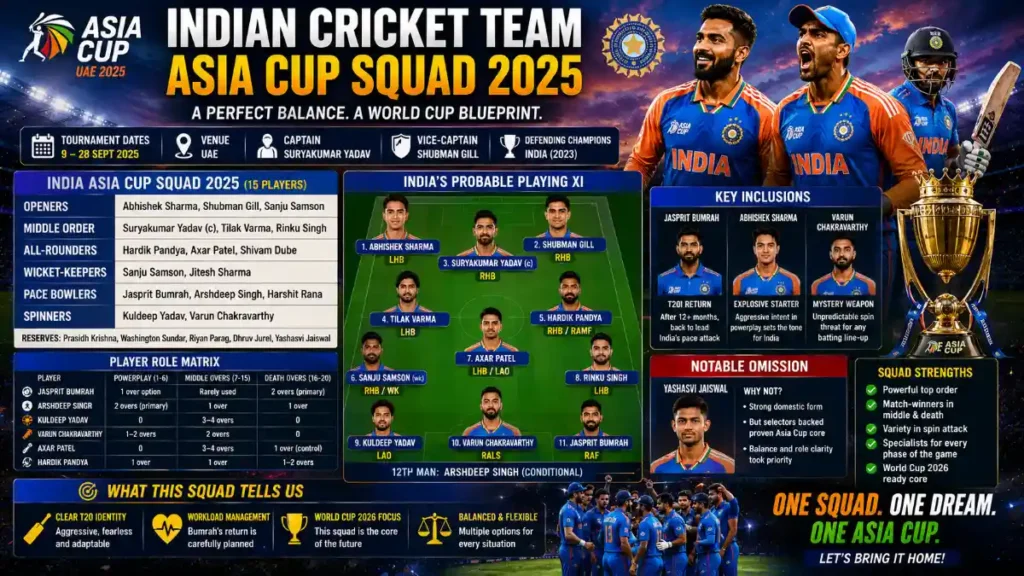
India’s 15-member Asia Cup 2025 squad is captained by Suryakumar Yadav, with Shubman Gill as vice-captain. Key inclusions are Jasprit Bumrah’s T20 return, Abhishek Sharma as first-choice opener, Tilak Varma in the middle order, and a three-spinner combination of Kuldeep Yadav, Varun Chakravarthy, and Axar Patel.
Full 15-Member Squad
| Role | Players |
| Captain | Suryakumar Yadav |
| Vice-Captain | Shubman Gill |
| Openers / Top Order | Abhishek Sharma, Shubman Gill, Sanju Samson |
| Middle Order | Suryakumar Yadav (c), Tilak Varma, Rinku Singh |
| All-Rounders | Hardik Pandya, Axar Patel, Shivam Dube |
| Wicket-Keepers | Sanju Samson, Jitesh Sharma |
| Pace Bowlers | Jasprit Bumrah, Arshdeep Singh, Harshit Rana |
| Spinners | Kuldeep Yadav, Varun Chakravarthy |
Reserves: Prasidh Krishna, Washington Sundar, Riyan Parag, Dhruv Jurel, Yashasvi Jaiswal
India’s Probable Best Playing XI
This is the section most squad pages skip — and it is exactly what fantasy players, analysts, and serious fans are searching for.
India’s strongest T20 XI from this Asia Cup squad balances left-right combinations, spin variety, and death-overs expertise across all 20 overs.
| Position | Player | Primary Role |
| 1 | Abhishek Sharma | Left-hand aggressive opener |
| 2 | Shubman Gill | Right-hand anchor opener |
| 3 | Suryakumar Yadav (c) | 360-degree middle-order anchor |
| 4 | Tilak Varma | Pressure-absorbing No. 4 |
| 5 | Hardik Pandya | Power finisher + pace option |
| 6 | Sanju Samson (wk) | Flexible middle-lower order |
| 7 | Axar Patel | Left-arm spin + lower-order bat |
| 8 | Rinku Singh | Death-overs left-hand specialist |
| 9 | Kuldeep Yadav | Wrist-spin wicket-taker |
| 10 | Varun Chakravarthy | Mystery spin powerplay option |
| 11 | Jasprit Bumrah | No. 1 T20 death bowler |
12th Man: Arshdeep Singh (replaces Rinku or Varun depending on conditions)
Player Role Matrix: Who Does What and When
This is the tactical layer that separates the Indian cricket team’s Asia Cup squad from every other T20 team on the continent.
| Player | Powerplay | Middle Overs | Death Overs |
| Bumrah | 1 over option | Rarely used | 2 overs (primary) |
| Arshdeep | 2 overs (primary) | 1 over | 1 over |
| Kuldeep | 0 | 3–4 overs | 0 |
| Varun | 1–2 overs | 2 overs | 0 |
| Axar | 0 | 3–4 overs | 1 over (control) |
| Hardik | 1 over | 1 over | 1–2 overs |
Key takeaway: India had a designated bowler for every phase of the game. No phase was covered by just one option. That is squad construction at its most advanced.
Why Bumrah’s Return Was the Biggest Selection Story
Jasprit Bumrah had not played a single white-ball game for India since the 2024 T20 World Cup final — over a year of deliberate absence from T20I cricket.
Bumrah was rested from T20Is for 12+ months after the 2024 World Cup to manage workload across formats. His Asia Cup return was the BCCI’s calculated decision to peak him for the T20 World Cup 2026 cycle.
The Workload Strategy Nobody Talked About
That gap was not an injury scare. It was a calculated preservation strategy by the BCCI and the national selection committee. The decision: protect Bumrah’s body across Test cricket during the ICC Future Tours Programme, then reintroduce him at the right white-ball moment. The Asia Cup 2025 was that moment.
What most people miss is this: Bumrah’s inclusion was never just about his wickets. It was a message to India’s entire bowling group about the standard expected at the top of the attack. When your No. 1 bowler can deliver 4 overs for 18 runs on a dry UAE pitch, the bowlers around him are forced to match that intensity.
He confirmed full fitness after clearing tests at the BCCI’s Centre of Excellence in Bengaluru, putting an end to weeks of speculation around a minor knee concern.
Bumrah’s Impact on the Tournament
- Bowled with pace and control throughout the tournament
- His presence in the death immediately changed how opposition captains constructed their final five overs
- Arshdeep’s performances improved noticeably with Bumrah operating at the other end — a direct pressure-sharing effect
The Indian cricket team’s Asia Cup squad benefited from Bumrah’s return in ways that don’t show up in just a wicket tally.
Captaincy: Suryakumar and the Long Game
Suryakumar Yadav returned to lead the India Asia Cup squad after clearing a fitness assessment following surgery that had kept him out of the bilateral series earlier in 2025.
SKY’s captaincy was retained not just for his batting, but for his ability to manage young players under pressure and rotate bowling combinations in real time — a rare T20 leadership skill.
What Selectors Never Said Publicly
Here is the real story: retaining Suryakumar as T20I captain through the Asia Cup and into the T20 World Cup 2026 was a deliberate continuity decision. Changing leadership before a World Cup creates instability. The selectors chose consistency over experimentation.
SKY’s batting was secondary. His actual value to this squad was leadership under pressure — specifically, his ability to reshuffle bowling orders mid-innings without hesitation and back young players in high-stakes moments. He demonstrated exactly that in the Asia Cup final, when India were reduced to 10 for 2 chasing 146 against Pakistan and did not panic.
Gill as Vice-Captain: The Long View
Shubman Gill’s promotion to vice-captain was the most forward-looking decision in this entire announcement. Gill is not being asked to just open the batting. The selectors are preparing him for the next leadership cycle — testing his ability to manage team dynamics and tactical conversations before the senior role eventually arrives.
Opening Combination: India’s Left-Right Advantage
The Abhishek Sharma-Shubman Gill opening partnership gave India a left-right dynamic that opposing bowling attacks genuinely struggled to plan around.
India’s opening pair of Abhishek Sharma and Shubman Gill complemented each other perfectly — left-right balance, aggression versus anchor, and the ability to disrupt opposition powerplay strategies.
Abhishek Sharma: From Backup to Match-Winner
Abhishek Sharma was not the headline name when the Indian cricket team’s Asia Cup squad was announced. He became the headline of the entire tournament.
- 314 runs across the Asia Cup
- Three consecutive half-centuries
- Strike rate of 200 — the highest of any batter in the tournament
- Player of the Tournament award
He was not just good. He was transformative — and his performances fundamentally shifted how selectors view the opening slot for the T20 World Cup.
What People Think vs. Reality: The Jaiswal Question
Many fans expected Yashasvi Jaiswal to walk straight back into the India Asia Cup squad on the back of his outstanding Test performances. The selectors made a different call entirely.
Jaiswal had not played a T20I since the Sri Lanka series. The selectors drew a hard line between Test-format form and T20I requirements. Disrupting a combination that was already functioning at the highest level — just to accommodate red-ball form — would have been a selection error, not a reward.
It was the right call. And the tournament results proved it.
Middle Order: Depth That Most Teams Can Only Dream Of
India’s middle order in this Asia Cup squad was not just deep — it was tactically designed to handle every pressure scenario a UAE T20 could throw at it.
India’s middle order features Tilak Varma as the anchor, Hardik Pandya as the finisher, and Rinku Singh as the specialist death-overs left-hander — three distinct skill sets covering three distinct match situations.
Tilak Varma: India’s Most Underrated Batter
Tilak Varma at No. 3 was the shrewdest call in this entire squad.
He does not generate headlines the way Suryakumar does. He is not a social media batter. But Tilak’s ability to anchor a collapsing innings — while maintaining a 131+ strike rate — makes him the most tactically important batter in India’s current T20 setup.
In the Asia Cup final against Pakistan, Tilak walked in at 10 for 2. He scored an unbeaten 69 from 50 balls. India won by five wickets.
That is not luck. That is a batter built for when the match is on the line.
Biggest Winners and Losers in the Middle Order
| Player | Status | Verdict |
| Tilak Varma | Big Winner | Cemented No. 3 role for World Cup |
| Rinku Singh | Solid contributor | Locked in as death specialist |
| Shivam Dube | Inconsistent | Position under pressure for World Cup |
| Sanju Samson | Functional | Flexibility valued over impact |
Rinku Singh: A Tool, Not a Passenger
Rinku Singh’s inclusion in the Indian cricket team Asia Cup squad was a specific tactical call, not a sentimental selection. He adds left-handed acceleration in the death overs — the ability to score 30 from 12 balls on a slow, dry pitch. That is a skill no other batter in this squad provides in quite the same way.
All-Rounder Engine Room: India’s Biggest Structural Advantage
Three all-rounders who can bat between No. 5 and No. 8 while contributing 8-12 combined overs is not just squad depth. It is a structural weapon that most T20 teams in Asia do not possess.
Hardik Pandya, Axar Patel, and Shivam Dube give India complete all-round coverage across batting positions and bowling phases — a combination that resolves the No. 7-8 weakness most T20 teams struggle with.
The All-Rounder Breakdown
- Hardik Pandya — explosive lower-order hitting, genuine pace at 135+ kmph, capable of single-handedly changing a match with bat or ball in any phase
- Axar Patel — left-arm spin that is almost impossible to attack on UAE surfaces, plus a batting strike rate above 160 in T20Is
- Shivam Dube — left-handed power option in the lower order and a medium-pace option for the powerplay when conditions assist
This is where things go wrong for most T20 teams: the No. 7-8 position becomes the weakest link when you need 15 off the last over. India converted that vulnerability into a structural strength.
The Best Finisher Debate: Rinku vs. Hardik vs. Dube
| Scenario | Best Option |
| Need 20 off 8 balls on a slow pitch | Rinku Singh |
| Need a lower-order 6 to build a total | Hardik Pandya |
| Need left-hand boundary hitting overs 16–18 | Shivam Dube |
| Need control batting to manage 120+ target | Axar Patel |
India’s Spin Arsenal: The UAE Conditions Advantage
The UAE pitch is not the Wankhede. It slows through the Dubai evening, grips off the surface, and turns just enough to make a high-quality spinner genuinely unplayable by overs 10-16.
India’s three-spinner combination — Kuldeep Yadav, Varun Chakravarthy, and Axar Patel — gave the team a separate tactical tool for every match situation, a luxury no other team at Asia Cup 2025 had.
Kuldeep Yadav: The Tournament’s Standout Bowler
Kuldeep Yadav was the leading wicket-taker of the Asia Cup 2025 — 17 wickets at an average of 9.29. His chinaman variations and disguised googly consistently wrong-footed batters at the top and middle of the opposition orders.
Varun Chakravarthy: The Mystery Option
Varun Chakravarthy became India’s go-to powerplay mystery spinner — an option almost no team in Asia had a pre-built answer for. Opponents who could not read his variations in the first over faced the prospect of facing another three before they found any rhythm.
Axar Patel: The Control Weapon
Axar operates differently from the other two. He is the containment specialist — over-the-wicket left-arm spin that restricts runs even when wickets are not falling. On a surface that grips, he can deliver four overs for under 20 runs while batting at No. 7 at a strike rate above 150.
What most analysts miss: These three spinners were never intended to play in the same XI. They are three separate answers to three separate tactical problems. Selectors built optionality into the squad — and that optionality won India matches.
Pace Attack: One Spearhead, Multiple Roles
The Indian cricket team’s Asia Cup squad pace attack was structured around a clear hierarchy with deliberate flexibility built underneath the top.
Bumrah leads. Arshdeep operates as the primary powerplay pacer. Harshit Rana provides aggression when conditions demand it. The combination gives India a full-format pace answer regardless of pitch and conditions.
Arshdeep Singh: India’s Powerplay Anchor
At the time of squad selection, Arshdeep Singh held India’s T20I No. 1 ranking among fast bowlers. His left-arm angle in the powerplay creates a different challenge for right-handed openers — making him a natural first-over choice and Bumrah’s most important support act.
Harshit Rana: The Surprise Weapon
Harshit Rana brings genuine pace at 140+ kmph and the tactical advantage of unfamiliarity. Opposition batters who have not faced him in a bilateral series have no reference point. In an ICC event environment, that unfamiliarity is a genuine weapon — especially against teams who have done limited homework.
Key Omissions: The Names That Didn’t Make It
No analysis of the India Asia Cup squad is complete without understanding who was left out — and precisely why.
Jaiswal (T20I absence), Shreyas Iyer (no tactical slot available), Shami (workload management), and Prasidh Krishna (pure-bowler limitation) were the four most significant omissions.
Who Missed Out and Why
| Player | Why Omitted |
| Yashasvi Jaiswal | T20I gap since Sri Lanka series; Abhishek-Gill opening pair locked in |
| Shreyas Iyer | No tactical slot at No. 4-5; Tilak and SKY occupy those positions |
| Mohammed Shami | Deliberate workload management; Test-format focus |
| Prasidh Krishna | India needed a lower-order bat at No. 8 more than a fifth pure bowler |
| Ishan Kishan | Out of BCCI favour at the time of selection |
Asia Cup 2025 Result: India Win Their Ninth Title
India won the Asia Cup 2025, defeating Pakistan in the final at the Dubai International Cricket Stadium on September 28, 2025.
India beat Pakistan by five wickets in the Asia Cup 2025 final, chasing 147 in 19.4 overs. Tilak Varma’s unbeaten 69 was the match-defining innings.
Pakistan scored 146 all out. India was in serious trouble at 10 for 2 inside the powerplay. Tilak Varma’s unbeaten 69 from 50 balls, combined with Hardik Pandya’s 34 from 19 balls, saw India home with two balls to spare.
India were unbeaten throughout the tournament — winning all Group Stage games, all Super Four fixtures, and the final.
Tournament Top Performers
| Stat | Player | Figures |
| Most Runs | Abhishek Sharma | 314 runs, SR 200 |
| Most Wickets | Kuldeep Yadav | 17 wickets, avg 9.29 |
| Player of Tournament | Abhishek Sharma | — |
| Player of the Final | Tilak Varma | 69* off 50 balls |
UAE Conditions Breakdown: Why This Squad Was Built for This Venue
The Indian cricket team’s Asia Cup squad was not assembled generically. It was engineered for UAE conditions specifically.
UAE pitches slow down through the night, grip for spinners from overs 8 onward, and offer swing in the powerplay during September. India’s squad had designated answers for every phase.
- Powerplay: Left-arm pace (Arshdeep) + mystery spin (Varun) disrupts rhythm early
- Middle overs (7-15): Kuldeep and Axar exploit turn and grip
- Death overs: Bumrah is world-class on any surface; Arshdeep backs him up
The condition-specific selection is what separated this India Asia Cup squad from previous India T20 squads that were selected on form alone and adjusted later.
What This Squad Reveals About India’s T20 World Cup Blueprint
The Indian cricket team’s Asia Cup squad was not assembled just to win one tournament in September 2025. It was a dress rehearsal under genuine ICC-level pressure.
The Asia Cup squad served as India’s T20 World Cup 2026 trial. The players who delivered — Abhishek, Tilak, Kuldeep — all retained their places. Minor adjustments were made, but the core stayed intact.
The T20 World Cup 2026, co-hosted by India and Sri Lanka, began in February 2026. The selectors used every Asia Cup match to confirm roles, test specific combinations, and identify who could perform when it genuinely mattered.
The squad that eventually travelled to the T20 World Cup made only minor adjustments — Ishan Kishan replaced Jitesh Sharma, Washington Sundar came in for Harshit Rana — but the core remained identical. That consistency tells you the Asia Cup selection was not a gamble. It was an audition with real career consequences. The three biggest winners from the audition are Abhishek Sharma, Tilak Varma, and Kuldeep Yadav. All three defined the tournament. All three kept their World Cup spots.
Frequently Asked Questions
Q1: Who captains the Indian cricket team in Asia Cup squad?
Suryakumar Yadav captains India’s Asia Cup 2025 squad. Shubman Gill serves as vice-captain and is being prepared for the next leadership cycle.
Q2: Is Jasprit Bumrah in India’s Asia Cup squad?
Yes. Jasprit Bumrah returned to India’s T20I setup for the first time since the 2024 T20 World Cup final. His inclusion in the Asia Cup squad was India’s most significant selection decision.
Q3: Why was Yashasvi Jaiswal not selected for the Asia Cup?
Jaiswal was excluded because he had not played a T20I since the Sri Lanka series. Selectors maintained the Abhishek Sharma-Shubman Gill opening combination that was already working effectively.
Q4: What is the full India Asia Cup squad list?
India’s 15-member Asia Cup 2025 squad: Suryakumar Yadav (c), Shubman Gill (vc), Abhishek Sharma, Tilak Varma, Hardik Pandya, Shivam Dube, Jitesh Sharma, Axar Patel, Jasprit Bumrah, Arshdeep Singh, Varun Chakravarthy, Kuldeep Yadav, Sanju Samson, Harshit Rana, Rinku Singh.
Q5: Did India win the Asia Cup 2025?
Yes. India won the Asia Cup 2025, defeating Pakistan in the final by five wickets. It was India’s ninth Asia Cup title — more than any other nation.
Q6: Who was the Player of the Tournament in Asia Cup 2025?
Abhishek Sharma won the Player of the Tournament award after scoring 314 runs at a strike rate of 200 — the highest of any batter in the tournament.
Q7: Who took the most wickets in Asia Cup 2025?
Kuldeep Yadav was the leading wicket-taker with 17 wickets at an average of 9.29 across the tournament
Q8: Why was Shreyas Iyer not in India’s Asia Cup squad?
Shreyas Iyer had no available tactical slot. Suryakumar Yadav and Tilak Varma had locked in the No. 3 and No. 4 positions, leaving no space for Iyer’s batting profile.
Q9: Who are the reserves in India’s Asia Cup 2025 squad?
India’s five reserves were: Prasidh Krishna, Washington Sundar, Riyan Parag, Dhruv Jurel, and Yashasvi Jaiswal.
Q10: How does India’s Asia Cup squad connect to the T20 World Cup 2026?
The selectors used the Asia Cup as a direct T20 World Cup 2026 trial. The core of the squad — Suryakumar, Bumrah, Abhishek, Tilak, Kuldeep — remained central to India’s World Cup selection, with only minor adjustments made after the tournament.