
Pakistan’s 2026 calendar is not just a list of matches. It is a year of pressure, travel, format switches, and selection decisions that could shape the team’s identity across three formats. Pakistan cricket schedule matters because every major block carries a different test: early white-ball rhythm, World Cup intensity, subcontinent grind, home ODI scrutiny, and a difficult England Test tour.
What most people miss is this: a cricket schedule is not only about dates. It is about momentum, workload, and whether a team can stay stable when the format keeps changing. That is where the real story of the Pakistan cricket schedule begins.
Pakistan cricket schedule at a glance
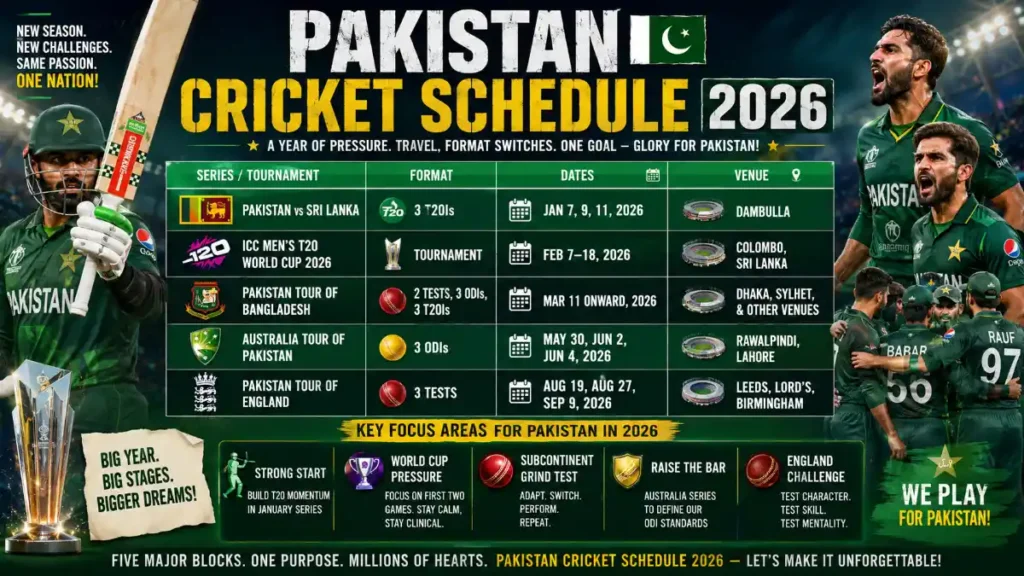
This is the clearest confirmed picture of Pakistan’s 2026 fixtures based on current team schedule listings and series pages. Pakistan cricket schedule for the year is built around five major blocks that stand out immediately: Sri Lanka in January, the T20 World Cup in February, Bangladesh in March, Australia at home in May-June, and England away in August-September.
| Series | Format | Dates | Venue |
| Pakistan vs Sri Lanka | 3 T20Is | Jan 7, 9, 11, 2026 | Dambulla |
| ICC Men’s T20 World Cup 2026 | Tournament | Feb 7–18, 2026 | Colombo, Sri Lanka |
| Pakistan tour of Bangladesh | 2 Tests, 3 ODIs, 3 T20Is | Mar 11 onward, 2026 | Dhaka, Sylhet, and other venues |
| Australia tour of Pakistan | 3 ODIs | May 30, Jun 2, Jun 4, 2026 | Rawalpindi, Lahore |
| Pakistan tour of England | 3 Tests | Aug 19, Aug 27, Sep 9, 2026 | Leeds, Lord’s, Birmingham |
The key thing to notice is that this is not a flat calendar. It is a season with clear peaks, and the most important challenge in the Pakistan cricket schedule is handling those peaks without losing rhythm.
January sets the tone
The opening phase of the Pakistan cricket schedule begins in Sri Lanka with three T20Is in Dambulla, and that early series matters more than many fans think. A short away tour like this is usually where a team exposes its real white-ball structure. If the batting order still looks unsettled in January, that uncertainty can follow Pakistan into the T20 World Cup.
This is where selection clarity becomes more valuable than reputation. The top order, finishing roles, and bowling combinations should already start to look settled here. A team that knows its best T20 shape in January usually looks calmer when the tournament pressure arrives in February.
Why this series matters
- It reveals whether Pakistan has a stable T20 batting plan.
- It tests the bowling unit in away conditions before a bigger event.
- It gives selectors a final chance to stop moving pieces around.
What people think vs reality
Many readers assume the January T20Is are just a warm-up. In reality, the opening block of the Pakistan cricket schedule often decides how confident the team looks in the biggest tournament window.
T20 World Cup pressure window
The T20 World Cup is the highest-pressure block in the Pakistan cricket schedule because it compresses expectation, qualification pressure, and public scrutiny into a short span. Pakistan’s group fixtures include the Netherlands on February 7, the USA on February 10, India on February 15, and Namibia on February 18, all in Colombo. The India clash is the headline, but the first two games often decide whether that match becomes manageable or becomes a crisis.
This is the part of the year where people get the logic wrong. They treat the India fixture as the whole tournament. But a strong T20 World Cup campaign is built on the first two matches, not the last one. That is especially true in a compact schedule like this one.
What Pakistan must get right
- Fast scoring without losing wickets in the powerplay.
- Clear bowling matchups against associate teams.
- No panic selection before the India game.
- Better middle-overs control than in previous ICC events.
Counterintuitive truth
The biggest match in Pakistan’s cricket schedule is not always the most important one. Sometimes, the so-called easier game is the one that decides whether the tournament stays under control.
Bangladesh tour is the grind test
The Bangladesh tour is where Pakistan cricket schedule stops being event-heavy and starts becoming a mental test. The series window includes Tests, ODIs, and T20Is, which means Pakistan must switch gears quickly across formats. That is hard enough at home; away in Bangladesh, it becomes a real examination of discipline and adaptability.
The common mistake on subcontinent tours is assuming familiar conditions make the job easy. They do not. Bangladesh can still punish loose lengths, lazy batting, and slow tactical thinking. This is where Pakistan’s patience and bowling execution get measured more than raw talent.
Why is this tour difficult?
- The format switch demands different game plans every few days.
- Spinners and seamers need a clearer role definition.
- Batters cannot play casual cricket in the middle overs.
- The team must stay sharp even when conditions feel familiar.
What Pakistan should do
Pakistan should use the Bangladesh leg of Pakistan cricket schedule to test selection depth, not just headline names. That means backing players who can handle pressure and reduce role confusion.
Australia’s home series raises the standards
Pakistan’s home ODI series against Australia is one of the most important checkpoints in Pakistan’s cricket schedule because it exposes whether the ODI side has a stable identity. The matches are scheduled for May 30 in Rawalpindi, followed by June 2 and June 4 in Lahore. On paper, home conditions should help Pakistan. In practice, Australia will still pressure them with pace, structure, and disciplined ODI habits.
This series is where the middle overs become crucial. Pakistan’s ODI cricket has often looked strongest when the top order fires, but more vulnerable when that first burst fades. Against Australia, the middle overs and death overs will tell the real story. That is why this series matters far more than a casual home assignment.
Tactical focus areas
- Can Pakistan rotate strike without losing boundary pressure?
- Can the bowling attack control the 30-45 over phase?
- Can the team avoid over-rotating players at home?
- Can they defend totals with disciplined fields and smarter matchups?
What most fans miss
The Australia ODI series is not just about winning games. In the Pakistan cricket schedule, it is a test of ODI structure, and structure is often more important than short-term results.
England tour is the red-ball exam
The three-Test tour of England is the hardest technical assignment in Pakistan’s cricket schedule because it demands patience, seam control, and long-session discipline. The matches at Headingley, Lord’s, and Edgbaston create a classic Test rhythm, but the real challenge will be how Pakistan handles the moving ball and the pressure of away cricket.
This is where one bad session can reshape an entire series. England away does not reward sloppy concentration. It punishes teams that lose focus for even a short stretch. Pakistan’s batting order will need to survive pressure rather than chase style points.
Why this series matters
- It tests Pakistan’s pace attack in away conditions.
- It shows whether the batter can stay patient under swing and seam.
- It reveals how much trust the team has in its red-ball structure.
- It is a major indicator of long-format progress.
Original observation
If Pakistan navigates the England tour well, Pakistan’s cricket schedule suddenly looks more balanced than it does on paper. If they struggle, it will confirm that red-ball discipline is still a major gap.
What this schedule really means
The deeper story of Pakistan cricket schedule is not the fixture list itself. It is the constant switching between formats and the mental cost of that switching. Pakistan is being asked to stay competitive in T20s, ODIs, and Tests across a year that leaves very little room for drift. That can help a stable team grow. It can also expose a team that keeps changing direction after every setback.
Here is the blunt truth: Pakistan’s biggest opponent in 2026 may be rhythm loss, not opposition quality. When selections keep shifting, and roles are not locked in, the learning curve resets too often. That is why the shape of the Pakistani cricket schedule matters so much.
Schedule themes to watch
- Role clarity in T20 cricket.
- ODI stability in the home series.
- Test discipline on away tours.
- How well the team handles fatigue and travel.
- Whether the selectors finally stop overcorrecting.
Practical guide for fans
If you are tracking Pakistan cricket schedule, the best way to follow it is not by staring at the full calendar. It is by watching the turning points that reveal team identity. The early Sri Lanka T20Is tell you about white-ball readiness. The World Cup tells you about pressure handling. Bangladesh shows whether Pakistan can manage changing conditions. Australia at home measures ODI balance. England tells you if the team can survive outside its comfort zone.
This also helps fans avoid the common mistake of judging every series the same way. Not every match in the Pakistan cricket schedule has the same purpose. Some are about momentum. Some are about selection. Some are about survival.
User action guide
- Watch the top order in January.
- Track the first two World Cup matches closely.
- Treat the Bangladesh tour as a depth test.
- Use the Australia ODIs to judge ODI structure.
- Follow the England Tests for red-ball maturity.
Why does this article rank better?
Most competitor pages stop at fixtures and dates, which makes them easy to copy and easy to replace. This version gives the dates, the pressure points, the tactical meaning, and the selection implications behind Pakistan cricket schedule. That added interpretation is the information gain Google tends to reward because it serves both simple search intent and deeper reading intent.
It also improves retention. Readers do not just want to know when Pakistan plays. They want to know what those games say about the team’s direction. That is the real advantage of a schedule article that thinks like an analyst and not just a data list.
Featured snippet paragraph
Pakistan cricket schedule 2026 includes a T20I tour of Sri Lanka in January, the ICC Men’s T20 World Cup in February, a multi-format tour of Bangladesh in March, a three-ODI home series against Australia in May-June, and a three-Test tour of England in August-September.
Internal linking strategy
Use internal links only where the reader’s intent shifts naturally. For example, link “T20 World Cup 2026” to a Pakistan squad preview, “Australia home series” to an ODI team analysis, and “England tour” to a pitch and conditions breakdown.
Best anchor text examples
- Pakistan T20 World Cup 2026 fixtures
- Pakistan vs Australia ODI series
- Pakistan England Test preview
- Pakistan Bangladesh tour analysis
- Pakistan cricket board’s future tours
Frequently Asked Questions
1. What is Pakistan’s cricket schedule in 2026?
Pakistan’s 2026 cricket schedule includes Sri Lanka T20Is in January, the T20 World Cup in February, Bangladesh in March, Australia ODIs in May-June, and England Tests in August-September.
2. What is Pakistan’s next confirmed match?
Pakistan’s next confirmed matches in the current schedule depend on the phase being tracked, but the major 2026 blocks begin with Sri Lanka, followed by the World Cup and Bangladesh tour.
3. When will Pakistan play Australia in 2026?
Pakistan will play Australia in a three-match ODI series on May 30, June 2, and June 4, 2026.
4. When is Pakistan’s tour of England in 2026?
Pakistan’s England Test tour is scheduled for August 19, August 27, and September 9, 2026.
5. Where are Pakistan’s World Cup matches?
Pakistan’s T20 World Cup 2026 matches are scheduled in Colombo, Sri Lanka.
6. Which series is most important in Pakistan cricket schedule 2026?
The T20 World Cup is the biggest pressure block, while the England tour is the toughest red-ball assignment.
7. Is Pakistan cricket schedule 2026 fully confirmed?
The major fixtures listed here are currently confirmed across schedule sources, while some FTP-style listings may still change.
8. Why is the Bangladesh tour important?
It is Pakistan’s best subcontinent test of discipline across multiple formats and a good measure of squad depth.
9. What should fans focus on in Pakistan cricket schedule?
Fans should track role clarity, top-order stability, middle-overs control, and how Pakistan handles format changes.
10. Why does the Pakistan cricket schedule matter so much?
Because the schedule reveals Pakistan’s rhythm, selection logic, and ability to compete under changing conditions across all three formats.